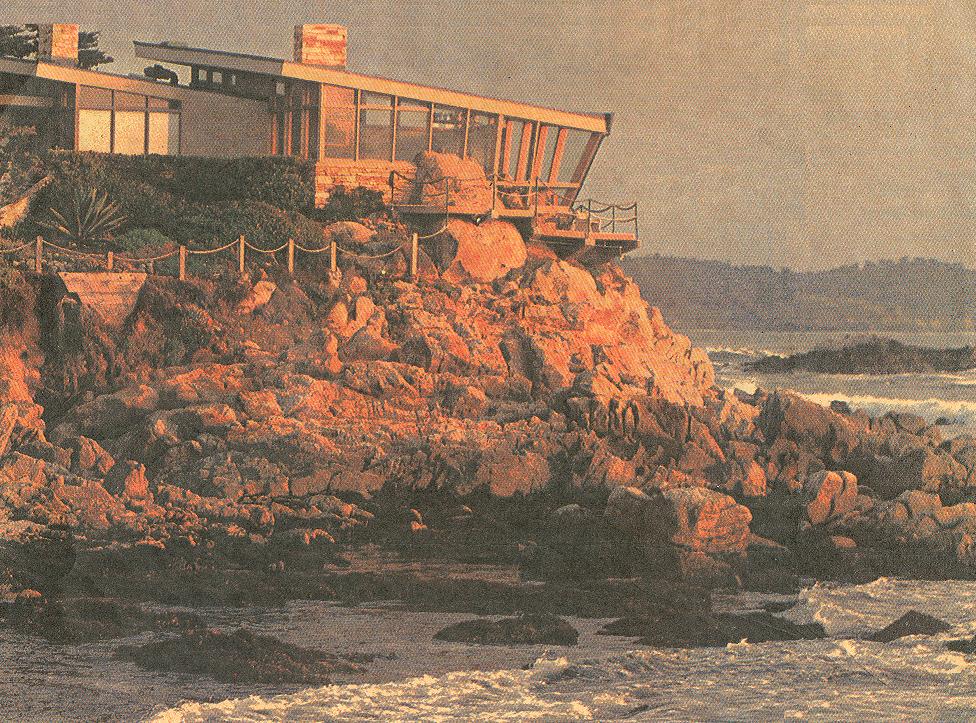
The Seaburst
The Seaburst House
26198 Scenic Road/or Ocean View Avenue
Carmel, California (1970)
Carmel-by-the-Sea
The Seaburst House was heated from below the wood flooring
with heated water pipes. There was a bird's eye view from
the cat walk, but if you were afraid of heights you certainly
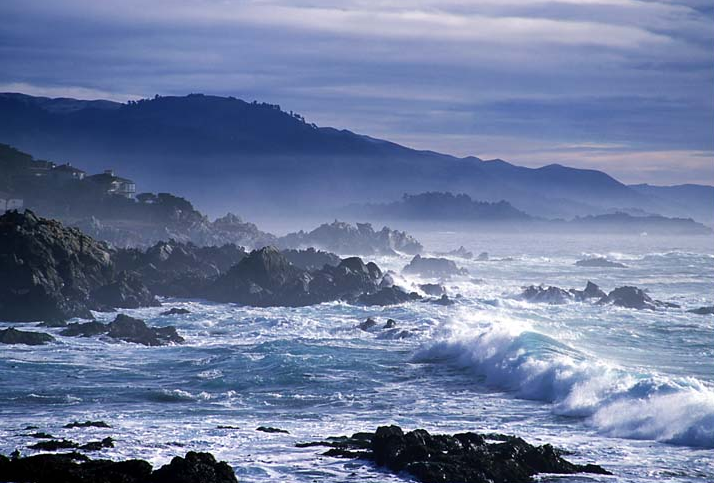
didn't want to be up there. The Ocean was always breaking
on the rocks below, and it was quite a site. On early mornings
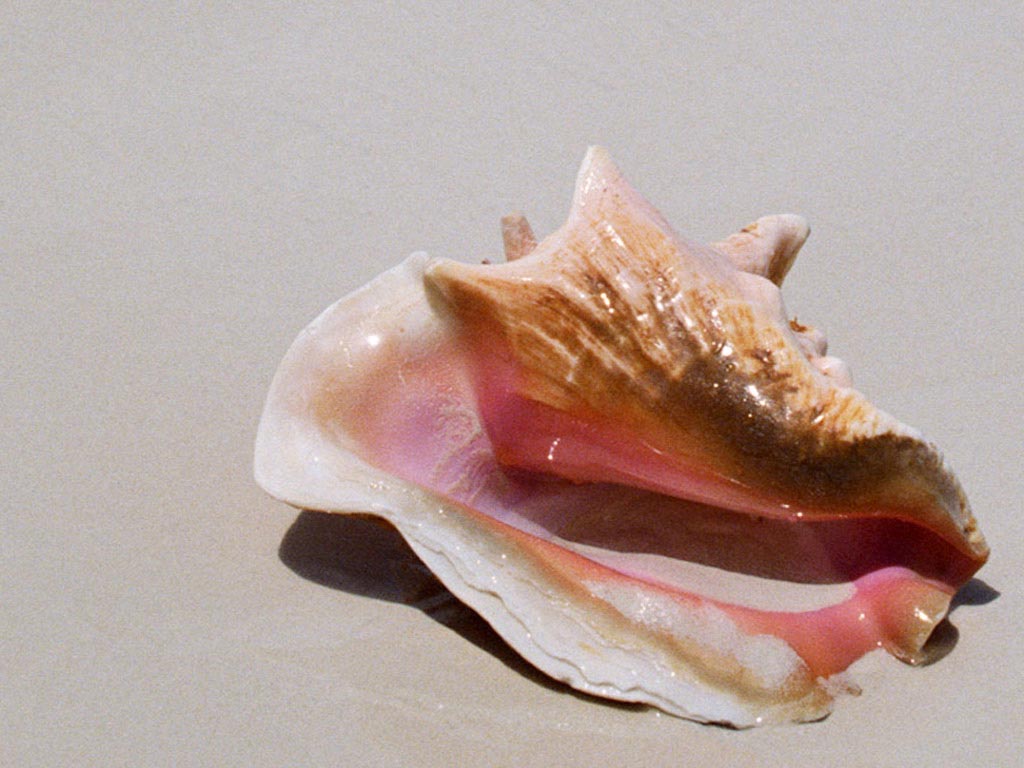
you could pick up sea shells while the tide was away. The
Dogs really loved it there, and there were always a lot of
fun things to do.
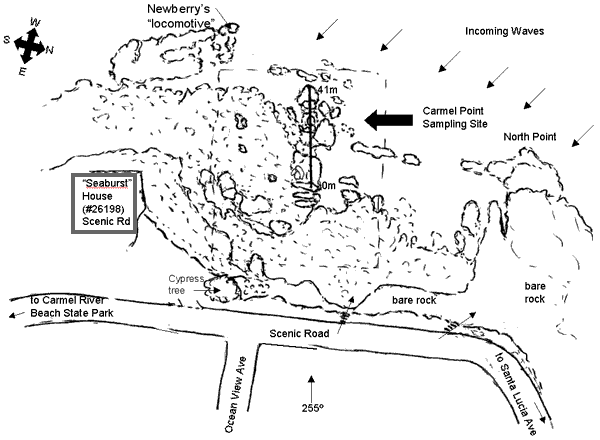
Seaburst Map
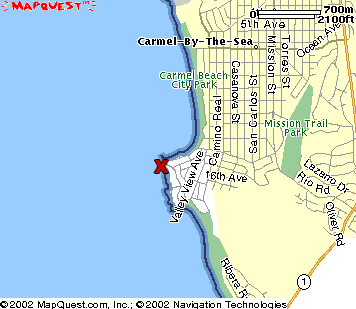
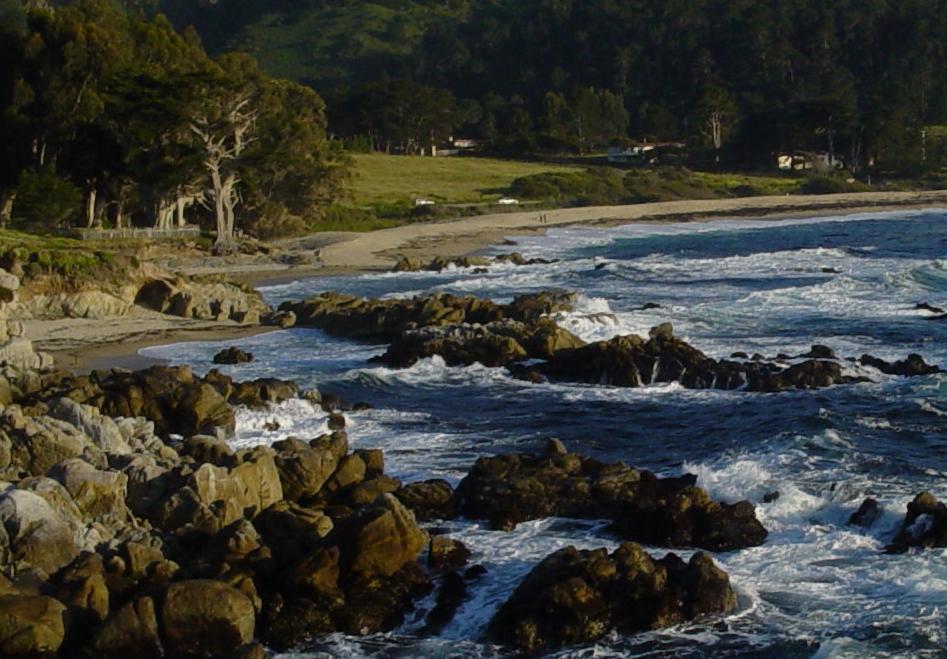
Scenic Road runs parallel to the shore along Carmel Beach then, at the south end of
Carmel Beach, turns westward and goes around Carmel Point to Carmel River Beach
State Park. The rocky outcrop and boulders at the Carmel Point site are very uneven
and difficult to traverse. It is easy to fall and slip into a tidepool. Be sure to
wear suitable shoes or waterproof boots.
Carmel Point (Carmel, CA.)
(Click Photo to Zoom in)
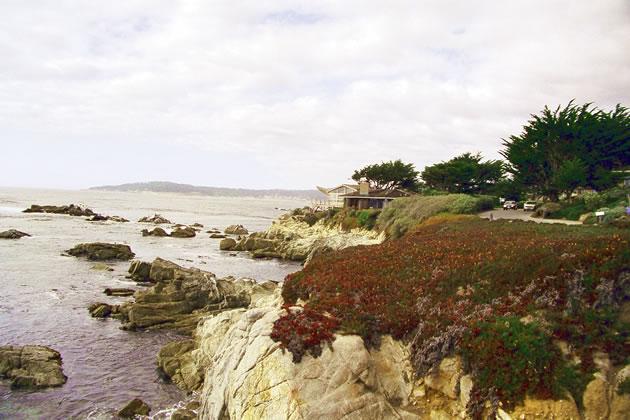
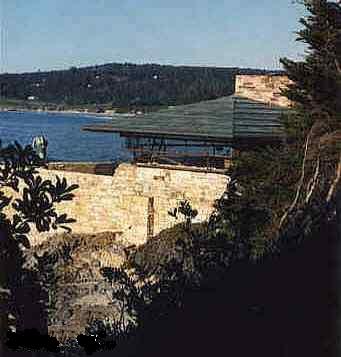
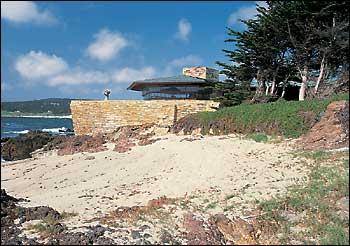
The large white house on the seaward side of the road called the Seaburst House.
Park on Scenic Road or Ocean View Avenue, across from the Seaburst House. This area
has many fine homes and people often walk or jog along the road. The mouth of the
Carmel River can be reached by driving further south, then east, on Scenic Road
around Carmel Point to the Carmel River Beach State Beach. (Galleries Link)
Carmel began forming in the late 1800’s on ground previously occupied by the
Ohlone Indians and the Spanish who built the still-existing Carmel Mission.
After the San Francisco earthquake of 1906, Carmel became a haven for artists
and bohemians escaping the big city. The history of the city was formed by such
artists as Jack London, Robinson Jeffers, Mary Austin, Upton Sinclair, Henry Miller
and Ansel Adams. It is still a city of artists and writers and many of them show
their work in the over 90 art galleries.
It is still home to famous people like Doris Day, whose pet friendly hotel is one
the town’s classic inns. As mayor from 1986-88, Clint Eastwood brought even more
reknown to the town that is a vacation favorite for thousands of visitors every year.
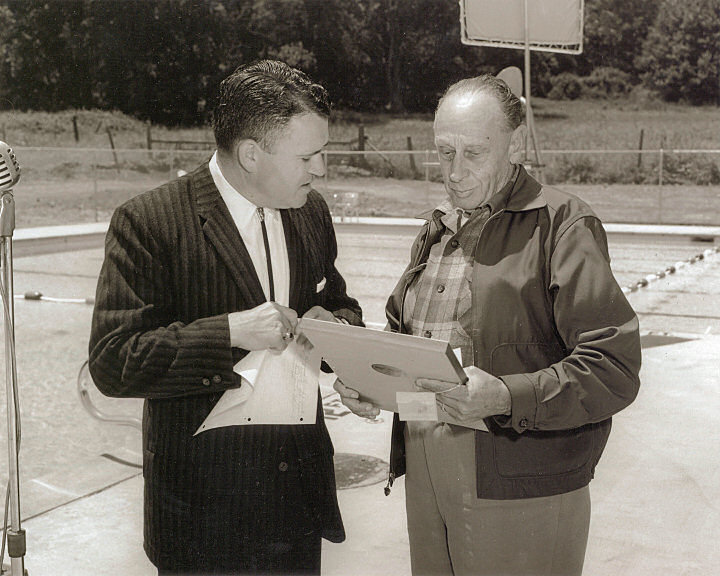
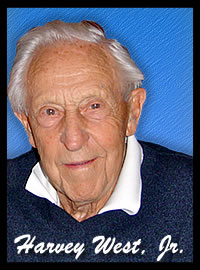
Harvey West was a family friend.
He presented to the City of Santa Cruz the
Harvey West Park in 1955
at the location 326 Evergreen Street CA 95060
Santa Cruz, CA
Harvey West Park History:
Harvey West Park was presented to the City of Santa Cruz by philanthropist
Harvey West in 1955.
Harvey West Park is a 50-acre municipal park. Located just off the intersection
of Highways 1, 9, and 17 and is truly Santa Cruz' most complete central park
complex. The park includes hiking trails, swimming pools, ball fields, play
equipment, clubhouses, barbecue pits, picnic areas and more. It's the perfect
place for team sports, a Sunday picnic, an evening swim or just a walk on the
trails.
Harvey West Biography:
Harvey West was born in Soquel in 1894. His Father, Ed West, was once
a County supervisor, better known as the "Bull of the Woods" for his
ownership of the Loma Prieta Lumber Company. Harvey worked for a time
at F.A. Hihn's sawmill on Laurel Street, then in 1913 he went to work for
Capitola Garage. He purchased the business in just four short years. On
his return from World War I, Harvey transformed the garage business into one for
hauling lumber. His success in the lumber business moved him to Calaveras County,
then to El Dorado County where he started the Placerville Lumber Company in 1936.
Over the years, Harvey West made many contributions, both public and private,
throughout the State of California. In 1955 he presented the City of Santa Cruz
with the parcel of land we know as Harvey West Park and in 1958 he purchased
Wagner Grove from Fred Wagner as an addition to the park.
Founder: Camp Harvey West El Dorado locale
385042N 1200448W - Echo Lake
Other Harvey West Philanthropist Activities: link
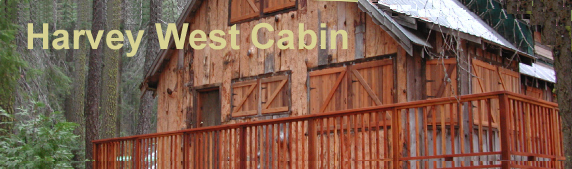
The Harvey West Cabin was constructed in the early 1930's by the Sacramento Box
and Lumber Company as an office and recreational facility. It was later purchased
by Harvey West, a prominent local businessman and philanthropist, and used as a
summer retreat by his family from 1936 to the early 1970's.
Harvey West Cabin
The Harvey West Cabin has propane lights and appliances, and a wood-burning stone
fireplace. The facility has two levels with a large open great room, dining room,
kitchen, two downstairs bedrooms, 1 1/2 bathrooms, and two large lofts overlooking
the great room.
Sleeping accommodations include 2 full size sofa sleepers, 1 full size futon, 2 double
beds, and 4 single beds. There are ample sleeping accommodations for at least 14 people.
The cabin itself can accommodate up to 20 people comfortably. The great room has a
propane heater and a large stone fire place (Firewood is supplied). Both bathrooms
have sinks and flush toilets. One bathroom has a shower.
Harvey West Cabin
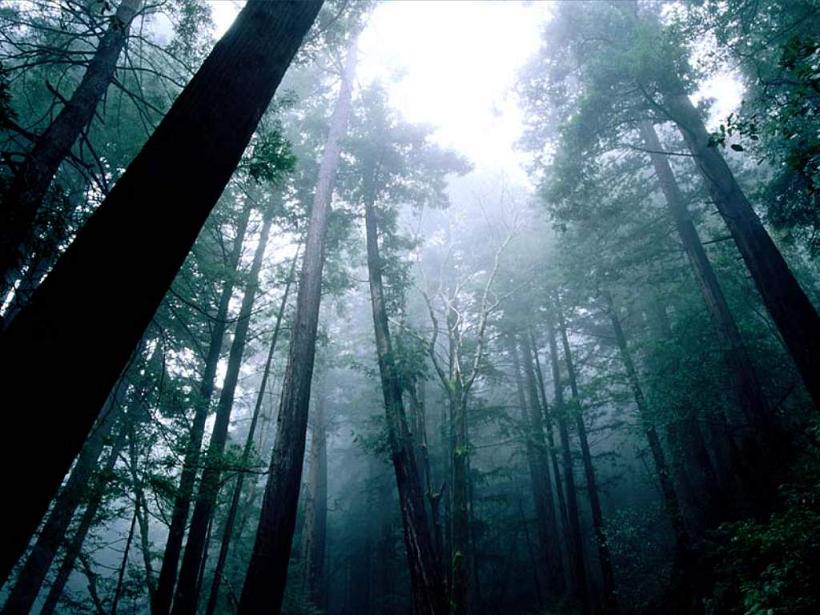
In Deep Redwoods
Kitchen: The kitchen area has a double sink, hot and cold water, a propane stove and
oven, a propane refrigerator, and a basic assortment of pots, pans, and utensils (if
you are not sure bring your own).
Water: The water comes from a new well and is tested regularly for contamination.
Exterior:
In addition to the 2,000 plus square feet cabin, a large deck overlooks the Silver
Fork River and is an excellent place for an additional sleeping area.
A cabin, donated by El Dorado County philanthropist and Placerville Lumber Company
owner, Harvey West, was moved by the Kyburz community to the site where the new
school now sits. The new Silver Fork School
was built during the mid-'50s.
Harvey West Donates Building to become the Pollock Pines Library: Link
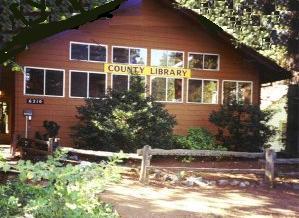
Doris Cloherty started the first Pollock Pines Library in 1952, using a couple of
shelves in her coffee shop. When Mrs. Cloherty closed her coffee shop, she and the
county librarian approached Mr. Harvey West about the possibility of constructing
a real library building. Mr. West built a small building on donated land in 1958.
When this became too small after a couple of years, the building was moved to Shingle
Springs and used as its branch library. Mr. West then built the present ski-chalet
like structure on the same site which serves as the branch today.
Pollock Pines County Library
Donated by Harvey West (Philanthropist)
Pollock Pines Library
6210 Pony Express Trail
Pollock Pines, California 95726
(530) 644-2498
Harvey West, Philanthropist Gives away Emerald Bay to the Emerald Bay State Park: Link
One of the most photographed spots in America, this secluded bay on Lake Tahoe, CA. has
its share of sight-seeing delights. Designated a National Natural Landmark in 1969,
Emerald Bay boasts clear blue waters rimmed with evergreens and granite cliffs.
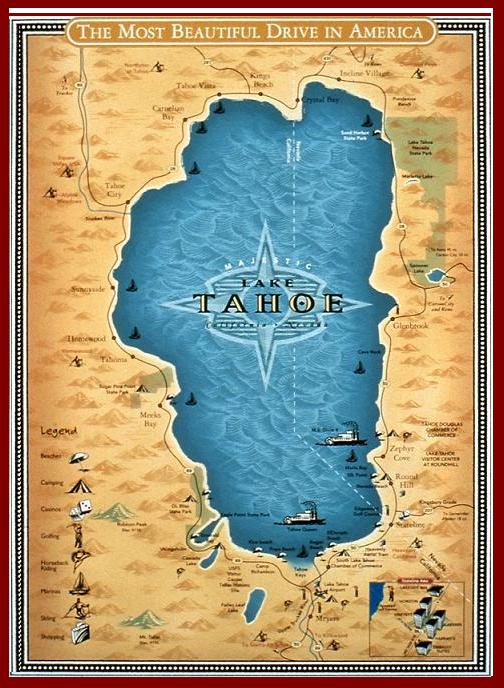
Lake Tahoe, CA. Scenic Drive Map
Emerald Bay State Park
Majestic Emerald Bay is just a small part of this beautiful and pristine State Park
covering 1,830 acres of the Sierra Nevada mountains. You will find six miles
This 593-acre within the state park on the southwest shore of Lake Tahoe, CA.
contains three major attractions: Emerald Bay, Eagle Falls and Vikingsholm Castle.
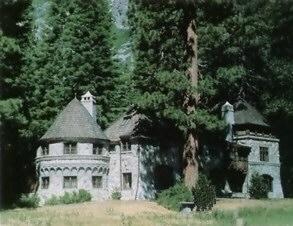
This 38-room mansion is a replica of an 800 A.D. Scandinavian castle.
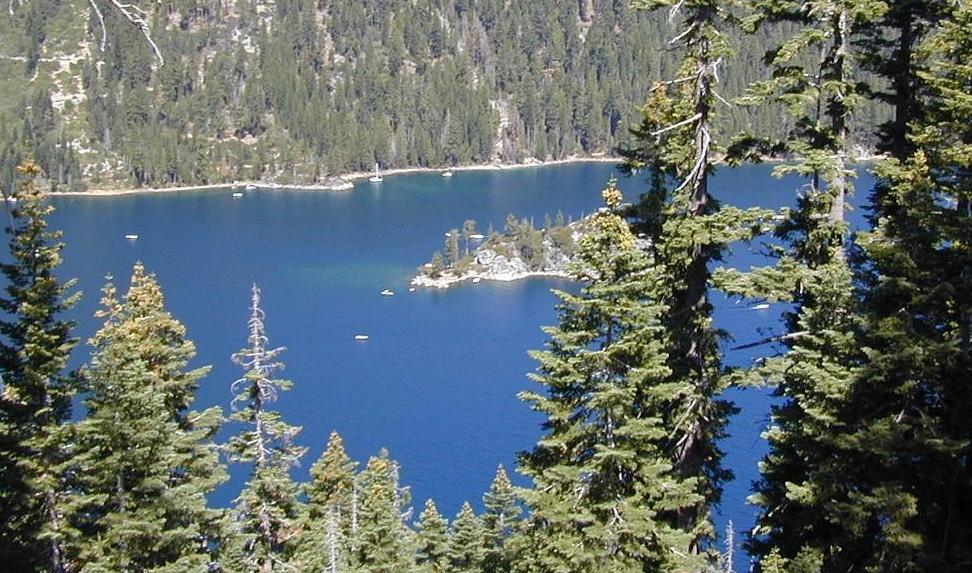
Emerald Bay: Tahoe's most photographed natural wonder, a glacier-carved blue and
turquoise bay surrounded by granite peaks, is spectacular any time of the day or
year. The blue-green bay is three miles long by one mile wide, with a narrow entrance
from the east. Motorists can find several excellent high vantage points along Highway 89,
or take one of a half-dozen tour boat excursions that circumnavigate the bay.
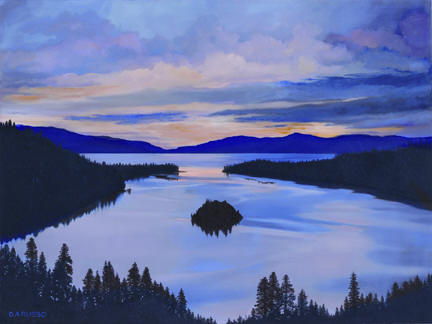
Emerald Bay, Fannette Island at Sunset
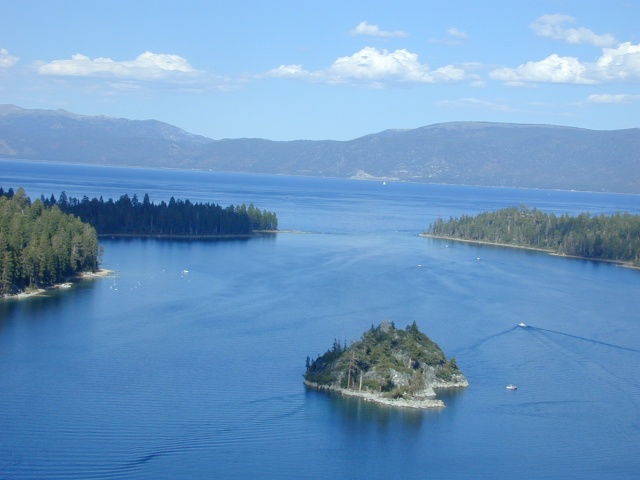
Emerald Bay, Fannette Island, Lake Arrowhead, CA.
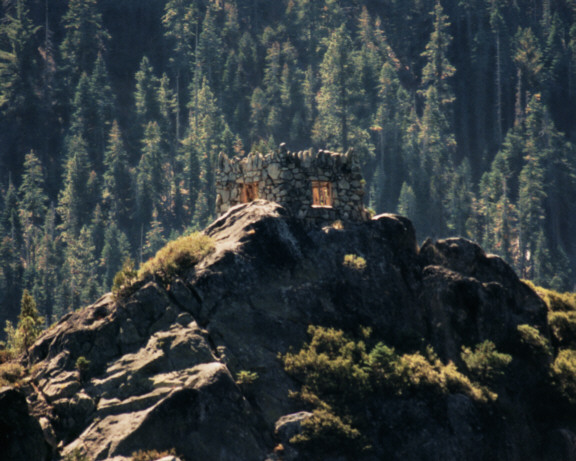
At the very top of Fannetee Island is the Tea Room, designed
in 1928-1929 for Mrs. Lora Josephine Knight by Swedish architect Lennart Palme
The Tea House, Emerald Bay Fannette Island, Lake Arrowhead, CA.
Fannette Island Donated to California State Parks
by Harvey West, (philanthropist)
Tea House is only accessible by Boat, as it is on the
only Island on Lake Arrowhead.
Within the bay is Fannette Island, the only island in the lake. Rising 150 feet above
the water, this rocky island, believed to be a remnant of the glacial action that
created the bay, is crowned by a crumbling stone structure called the "Tea House."
This structure on top of the island is not a castle, it is just a 16 foot square open
roofed room. It is called the "Tea Room" because it was originally built for sitting
in and having tea. Mrs. Lora Josephine Knight had this room built in 1929 so she
could enjoy the island views with her friends for an afternoon tea. Fannette Island
was not always known by that name. During the past 100 years it has been known as
Coquette, Fannette, Baranoff, Dead Man's, Hermit's, and Emerald Isle. Fannette was
the name that finally stuck.
Donated by: Harvey West California State Parks (Vikingsholm)
Harvey West Vikingsholm and Emerald Bay Island Story:
The nucleus of Emerald Bay State Park, including Vikingsholm,
was given to the State
by Placerville lumberman Harvey West in 1953. The Save the Redwoods League was
instrumental in the excision. From the crest of Eagle Falls, you can
see a panorama of Emerald Bay, Fannette Island, Lake Tahoe, CA., and the distant Nevada
shore. Read more or call 530-541-3030.
Vikingsholm can be reached by parking in the Harvey West parking lot by Highway 89
at Emerald Bay. Take the trail, which is one mile in length and drops 500 feet in
elevation to the house.
Harvey West Owns Emerald Bay, Lake Tahoe, CA., California: Link
In the early 1900s, Tahoe was a summer haven for the families of San Francisco
tycoons. Guests stayed in private log cottages or in the main houses, whose
exteriors ranged from Sierra rustic to Scandinavian romantic, with comfortable,
even elaborate interiors.
Emerald Bay provided the setting for one of the first summer homes at Lake Tahoe, CA..
In 1863 Ben Holladay, stagecoach magnet and early day transportation king pre-empted
land in Emerald Bay and built a summer home. In 1884 a Dr. Kirby bought 500 acres
in the Bay and built a resort. A portion of the Kirby land was sold to the William
Henry Armstrong family in 1895.
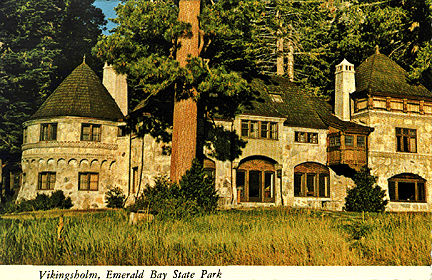
Vikingsholm, Scandinavian Design
Vikingsholm Vintage Postcard - Emarld State Park
In 1928 Mrs. Lora Josephine Knight, purchased about two hundred acres of land at
Emerald Bay in the Lake Tahoe region of California. The property encompassing the
head of Emerald Bay and Fannette Island in 1928 for $250,000.
Mrs. Knight was not a newcomer to the Tahoe Area. For 16 years, Mrs. Knight had
enjoyed her summer home, Wynchwood, at Observatory Point on the North Shore.
This property was later sold to Robert Stanley Dollar, Sr., and is now known as
Dollar Point. It was there she decided to build a structure that would incorporate
the atmosphere and design of an old Viking castle of stone construction. The castle
was built in the shape of a horseshoe with two wings enclosing a courtyard. The
main portion of the castle was designed on two stories with a square, three-story
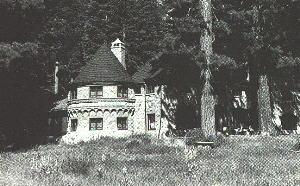
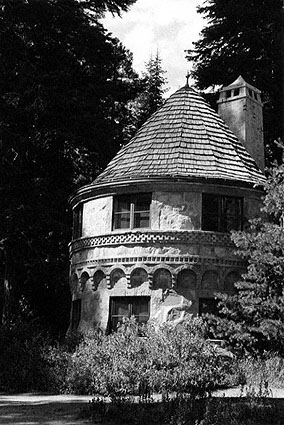
tower having a pyramidal roof. A circular tower, two-stories high with a conical
roof, is located opposite the square tower at the other end of the castle. Excavation
and foundations were begun in late August of 1928.
Vikingsholm Castle
Mrs. Lora Josephine Knight spent many happy years at Vikingsholm Castle, but she died
in 1945, leaving her magnificent Vikingsholm Castle as a true monument of ancient
Scandinavian architecture. Vikingsholm is now preserved in Emerald Bay.
Vikingsholm Castle (Main Entrance)
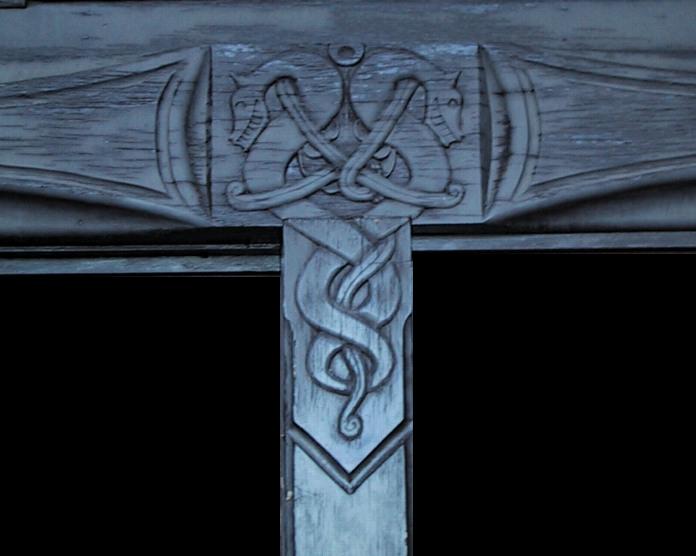
vikingsholm Castle (front door way)
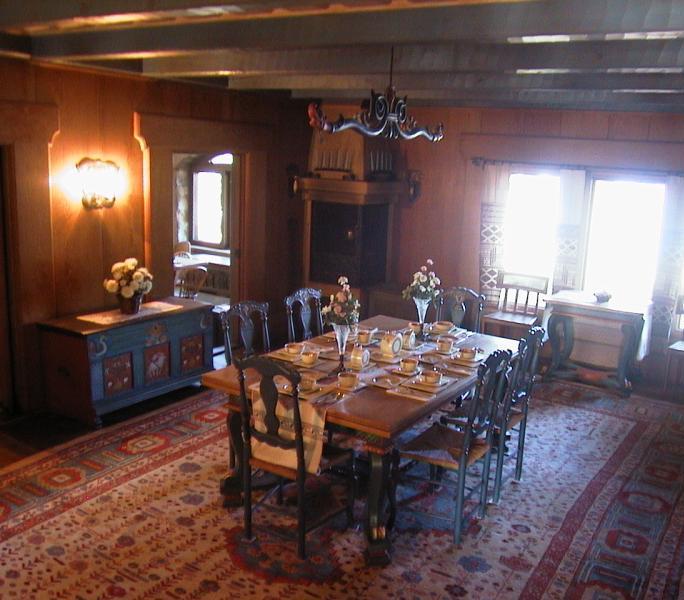
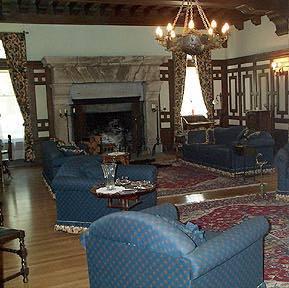
vikingsholm Castle (Dining Room)
Vikingsholm, With Excellent Scandinavian Design:
The former summer home of millionaire heiress Lora Knight, Vikingsholm was built in
1929. Vikingsholm is located at the head of Emerald Bay in Lake Tahoe, California.
This magnificent "castle" is a unique blend of Nature's spectacular beauty and man's
architectural ingenuity. Vikingsholm, situated majestically among towering pines and
cedars, was built as a summer home for Mrs. Lora Josephine Knight in 1929 by
architect Lennart Palme who drew inspiration from Norse castles and dwellings.
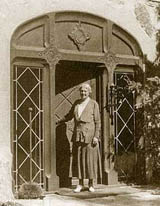
Mrs. Lora Josephine Knight
Vikingsholm Estate, Emarld Bay, Lake Tahoe, CA.
Because the rugged mountain scenery and sheer granite cliffs surrounding Emerald
Bay reminded her of the fjords in Norway, Knight chose a Scandinavian design. It's a
house with many unusual features, from a sod roof seeded with wildflowers to dragon-heads
at the peak of the roof which covers both the north and south wings of the complex.
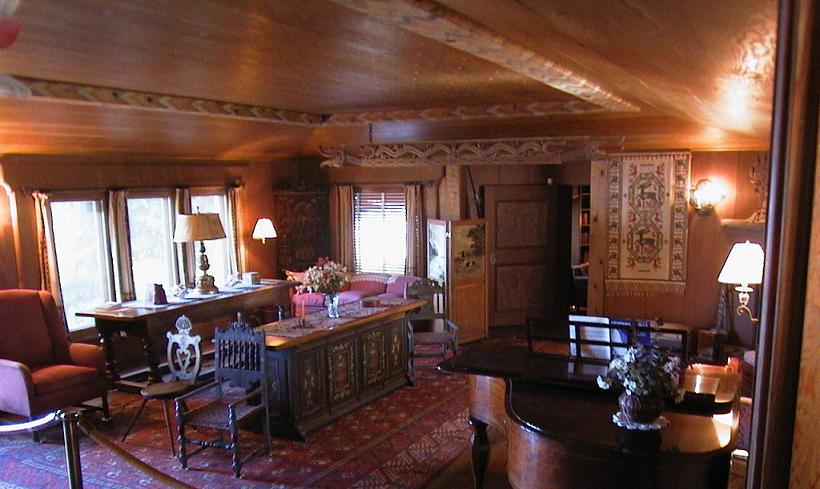
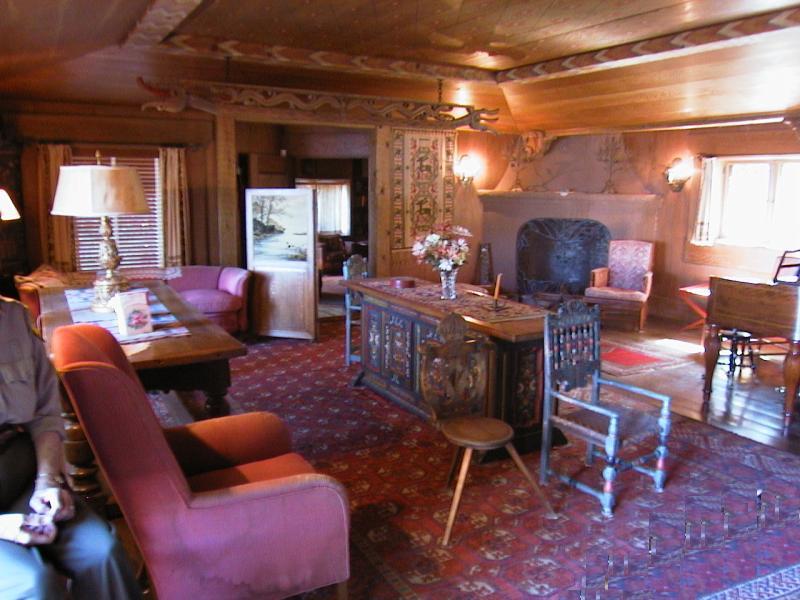
Inside the front door guests meet Selma, a folk art clock. Upstairs, the delicate
colors of the stained paneling are unchanged, and Mrs. Lora Josephine Knight's collection of
Scandinavian antiques and museum reproductions are as interesting as the architecture
itself.
Vikingsholm Emerald Bay - Early Days
Helen Smith spent the first fourteen summers of her life, with her parents, as
Mrs. Lora Josephine Knight purchased the land from the Armstrongs in 1928. Mrs. Lora
Josephine Knight's land included the only island (Fanette Island) in Lake Tahoe and
the only water fall (Eagle Falls) flowing directly into the Lake. Magnificent cedars
and pines set off by shear granite cliffs make this one of the most scenic areas in the
entire United States. Mrs. Lora Josephine Knight wanted to build a summer home that
would compliment the magnificent natural surroundings. Emerald Bay reminded her of many
of the fjords she had seen on numerous travels to Scandinavia. She commissioned her
nephew by marriage, Lennart Palme, a Swedish architect, to design the plans.
In 1928 Mrs. Lora J. Knight of Santa Barbara purchased this isolated site at the
head of Emerald Bay. She instructed Lennart Palme, a Swedish-born architect and
nephew by marriage, to design a home without disturbing a single one of the site's
magnificent trees. After a trip to Scandinavia, they decided to reproduce Norwegian
farmsteads, wooden stave churches and a castle. Vikingsholm was completed in
September 1929. Mrs. Lora Josephine Knight also had guest houses and the tea house
on Fannette Island built. Only a motorboat could reach the island tea house where
residents and guests once enjoyed afternoon refreshments at a large oak table in the
center of a room 16 feet square.
Vikingsholm Architecture
Mrs. Lora J. Knight spent her summers at the Vikingsholm home until her death in
1945. Vikingsholm Castle: Getting to this unique mansion requires a hike down a
steep, one-mile paved trail that drops 500 feet in elevation. But it's worth the
effort, because visitors will see one of the finest examples of Scandinavian
architecture in the Western Hemisphere. Vikingsholm was built in 1928-29 by Mrs. Lora
Josephine Knight, who spared no expense to create a replica of an 11th-century Viking
castle. The granite foundation and stonework, turrets and high-pitched roofs-some of
them covered by sod-were constructed out of materials found at the lake.
An army of 200 workers completed the 38-room mansion in just one summer, using
old-fashioned techniques of hand-hewing huge timbers and forging hinges and latches.
Some sections of the home contain no nails, pegs or spikes. Most of the material
to construct the home came from the Tahoe Basin. The ideas for the construction
came from buildings dating as far back as the 11th century.
During the construction, Mrs. Lora Josephine Knight prowled the cities of Norway,
Finland,
Sweden and Denmark for 18th- and 19th-century antique furniture, and what
she couldn't buy she had duplicated, as precisely as possible, from drawings of museum
pieces. Tours, offered every half hour in summer, allow visitors to see two ornately
carved dragon beams, paintings on ceilings and walls, and six fireplaces of Scandinavian
design. Vikingsholm has a nominal admission fee. Open daily 10 AM through 4 PM, mid-June
through Labor Day. Parking in the lot on Highway 89 is free. Information: Eagle Point
Campground, (916) 541-3030 (summer only); D.L. Bliss State Park, (916) 525-9529.
D.L. Bliss State Park:
North of and adjacent to Emerald Bay State Park (they are administered jointly,
and basically considered to be D.L.Bliss/Emerald Bay State Park), shoreline of
D.L. Bliss stretches from slightly north of Rubicon Point to slightly north of
Emerald Point.
Hwy 89
Emerald Bay, CA
(530) 525-7277 or (530) 525-7232
Emerald Bay State Park:
Primitive boat camp with moorings, piers, and beaches; Vikingsholm Mansion,
hiking (beautiful waterfalls), Fanette Island with the famous tea house, strenuous
climb to the parking lot.
Hwy 89
Emerald Bay, CA
(530) 525-7277 (530) 525-7232
Vikingsholm Castle
The methods and materials used in the construction of Vikingsholm, including the
granite boulders of the foundations and walls, are those used in ancient Scandinavia.
Towers, intricate carvings and hand-hewn timbers were used to create the home.
The sod roofs with their living grass and flowers are reproduced from actual
sites in Norway. A step into Vikingsholm is like a step back into medieval
times and a chance to gain an appreciation of a unique style of architecture
No expense was spared in building and furnishing this castle. Many of the furnishings
that Mrs. Lora Josephine Knight wanted for Vikingsholm were so historically significant
that their export was forbidden by the Norwegian and Swedish governments. Therefore,
she had the furnishings copied in detail, down to the measurements, colorations and
aging of the wood.
In the summer of 1928 Mrs. Lora Josephine Knight and the Palmes traveled to Scandinavia
to gather the ideas they wanted to incorporate in Vikingsholm. Vikingsholm was completed
in the fall of 1929 and occupied by Mrs. Lora Josephine Knight, her staff of 15 and many
guests in June of 1930. Mrs. Lora Josephine Knight enjoyed 15 summers at Vikingsholm. She
always had a home full of guests to share this magnificent summer home with her. Mrs. Lora
Josephine Knight passed away at the age of 82 in 1945. After her death, the home was sold
to Lawrence Holland, a rancher from Nevada.
He subsequently sold it to Harvey West, a lumberman from Placerville, California.
In the early 1950s, Mr. West, a noted philanthropist, negotiated with the State of
California and said he would donate one-half of the appraised value of the land,
as well as the Vikingsholm itself outright, if the State would pay him the other half.
This arrangement was agreed upon, and in 1953 the house and property were acquired by
the State. Vikingsholm is considered to be one of the finest examples of Scandinavian
architecture existing in the United States. It is now a part of the Harvey West Unit
of the Emerald Bay State Park. The house is open for tours in the summer months and the
grounds and magnificent scenery may be enjoyed all year around by those wishing to
visit this beautiful setting.
Emerald Bay, Fannette Island, Lake Tahoe, CA. - Tea House (Visited by
Harvey West's Friends & Family)
Donated By: Harvey West, Placerville Lumberman (Philanthropist)
Emerald Bay, Fannette Island - The only island on Lake Tahoe, CA., this is the site
of Mrs. Lora Josephine Knight's Tea House, a rustic structure that resembled a
mini-castle with a large oak table and a small fireplace. Only the shell remains
today. The island is inhabited by Canada geese in springtime, and families of geese
can often be seen swimming along the shoreline of Emerald Bay. Vikingsholm Project
officially started in January 1999. The purpose of the project is to supplement
available state funds to preserve the structure," explains Helen. To date, $1.6
million in funding has been raised and will hopefully exceed $2 million.
Read more or call
530-541-3030.
Another interesting site in the area is the Ehrman Mansion, Sugar
Pine Point State Park on Lake Tahoe, CA.'s West Shore at Tahoma:
Link or
the Tahoe Tavern: Link
Ehrman Mansion. Built for Isaias W. Hellman, a Bavarian immigrant who became a
San Francisco bank mogul, the imposing main house dates from 1902. In 1965, the
state acquired the property, including nine outbuildings and nearly 2,000 acres
that now form Sugar Pine Point State Park. Sugar Pine Point is a forested promontory
on the western side of Lake Tahoe. The park includes a mile and three quarters of
lake frontage with a number of sandy beaches and a unique natural area where the
untouched, primeval forest of the Tahoe Basin marches right down to the water's
edge.
Ehrman Mansion:
Refurnished last year, the 11,703-square-foot Queen Anne has 16 rooms open to
view. Tours begin Memorial Day weekend, then run daily starting June 16; they're
given every hour between 11 and 4. From State Highway 89, turn toward the lake
at Sugar Pine Point Picnic Area.
Ehrman Mansion, Lake Tahoe, CA.
The Ehrman Mansion grounds, at Sugar Pine Point State Park,
provide a pleasant environment for cross-country skiing.
The Tahoe Tavern
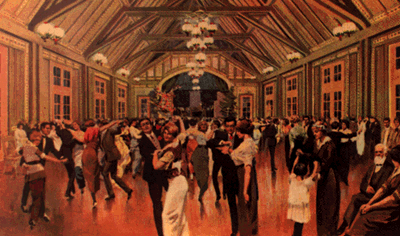
1901 - 1964
"Opulence and Isolation"
Tahoe City's history
The Seaburst House
Ocean View/Scenic Drive Carmel, CA
Built by Architect Frank Lloyd Write
and Associates
By Frank Loyd Write, Architect
Carmel By The Sea
Carmel-by-the-Sea (one of the triad which includes Carmel Valley
and Carmel Highlands).
The Passion of Frank Lloyd Write: Link
The Seaburst House is next to the three-level Butterfly House Photo
Butterfly House
known for its winged architecture. Near the Copper Roof on Scenic Drive.
Neighbor, Kim Novak, Actress
The other neighbor, The Van Loubensell Octogon House,
all along the Carmel Beach, CA.
Bad Winters would bring the Ocean right
into the living room!
"'Think simple'" as my old master used to say - meaning reduce the whole of its
parts into the simplest terms, getting back to first principles." Link
City of Carmel-by-the-Sea: Carmel City in 1888; about 1904 became an artist and writers
center and retains much of its Bohemian village flavor. In Carmel and nearby are a
Frank Lloyd Wright house, the "Butterfly House" and Robinson Jeffers' Tor House.
Overview: Carmel Surrounding Area Link
The exclusive enclave of Carmel-by-the-Sea (to give its complete name) began life
in the early years of the 20th century as a small but lively bohemian colony inhabited
by the literary likes of Sinclair Lewis, Mary Austin, and Upton Sinclair. However,
with a few arts-and-crafts exceptions, by the 1950s Carmel had turned into the archly
conservative and contrived quaint community it is today - a place where Marie
Antoinette would no doubt feel at home, dressing down as a peasant, albeit in Chaps
by Ralph Lauren. Preserving its rural feel by banning street addresses (and skateboards,
and home mail delivery), Carmel simultaneously loves and abhors the many thousands of
tourists who descend on it every weekend to window-shop its many designer boutiques
and galleries that fill the few blocks off Ocean Avenue, the main drag through town.
Though it's easy to be put off by the surface glitz, Carmel does have a lot going
for it. The water is too cold and treacherous for swimming, but broad City Beach
at the foot of Ocean Avenue gleams white against a truly azure cove. To the south,
aptly named Scenic Drive winds along the rocky coast, past Robinson Jeffers's
dramatic Tor House and a seafront Frank Lloyd Wright house (the latter now owned
by rock star Sammy Hagar) to another broad beach at the usually unpopulated Carmel
River State Park, a favorite spot for scuba divers exploring the deep undersea canyon.
Above the beach, just west of Hwy-1 a mile south of central Carmel, Carmel Mission
(daily 9:30 am-4:30 pm; donations) was the most important of all the California
missions, serving as home, headquarters, and final resting place of Father Junipero
Serra, the Franciscan priest who established Carmel and many of the 20 other
California missions, and who is entombed under the chapel floor. The gardens -
where on weekends wedding parties alight from limos to take family photos - are
beautiful, as is the facade with its photogenic bell tower; this is the mission
to visit if you visit only one.
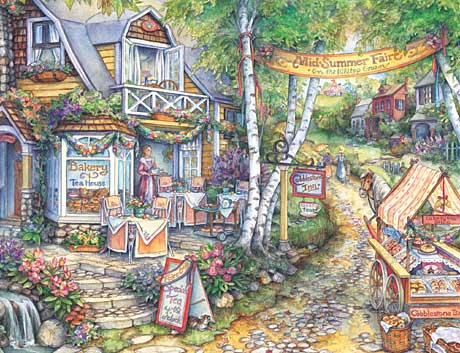
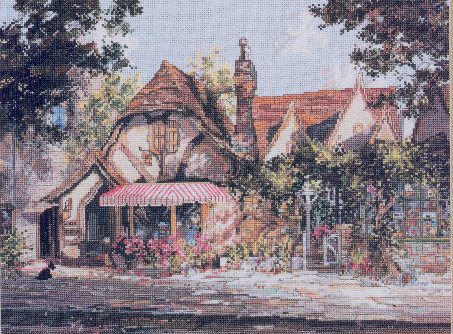
Tuck Box Tea Room
Thomas Kinkade Rendition
Dozens of good and usually expensive restaurants thrive in Carmel, but one place
to see, even if you don't eat there, is the tiny, mock-Tudoresque Tuck Box Tea
Room on Dolores Street near 7th Avenue. Rebuilt after a fire but still doll's-house
cute, it serves up bacon-and-eggs breakfasts and dainty plates of shepherd's pie
and Welsh rabbit for lunch; closed Monday and Tuesday. At the other end of the
aesthetic spectrum is The Hog's Breath Inn, on San Carlos between 5th and 6th Avenues,
owned by Clint Eastwood and specializing in "Dirty Harry" burgers and "Sudden Impact"
sausages served to patrons seated on an outdoor patio. If you'd rather join locals
than mingle with your fellow tourists, head to Katy's Place, on Mission Street
between 5th and 6th, serving some of the world's best eggs Benedict.
Carmel has only one place approximating a budget option, the very pleasant Carmel
River Inn (831/624-1575 or 800/882-8142) just west of Hwy-1 near the Carmel Mission,
but even here rates average $100 a night. However, if you want to splurge on a bit
of luxury, Carmel is a good place to do it. Besides the golf course resorts of
nearby Pebble Beach, Carmel also has the commodious, 1920s-era, mission-style Cypress
Inn at Lincoln and 7th (831/624-3871 or 800/443-7443), partly owned by dog-loving
Doris Day (and featuring posters of her movies in the small bar off the lobby),
with rooms from under $150. A relaxing spot away from downtown is the Carmel
Mission Ranch, 26270 Dolores Street (831/624-6436 or 800/538-8221), within walking
distance of the beach and mission and offering resort-level facilities at room rates
that run close to $250 a night. At all of these places these are peak-season rates;
off-season rates will be much lower, so be sure to ask about any special deals that
might be on offer.
It always feels like Spring in Carmel-by-the-Sea. Perennially flowering gardens,
charming cottages and endless white sand beaches entice visitors to return year
after year. Tucked away in a quiet corner of this haven is the English-country
Cobblestone Inn.
Cobblestone Inn, Carmel, CA.
The Inn is a charming addition to the natural beauty of Carmel. Stone from the
Carmel River completely covers the lower level of the Inn and surrounds the fireplace
in each guest room. Breakfast is savored each morning on the flowering patio and
afternoon wine and hors d'oeuvres are enjoyed in front of the crackling fire in
our comfortable dining room.
Helpful to Know
o Though most of Carmel's many art galleries seem directed at interior decorators,
a few are worth searching out, including the Photography West Gallery on the
southeast corner of Dolores and Ocean Streets, and the Weston Gallery on Sixth
Avenue near Dolores Street, featuring the works of Edward Weston, Ansel Adams,
and other Carmel-based photographers.
o Carmel's leading light, Clint Eastwood, seems ever-present: besides serving
as mayor for many years, he owns the Hog's Breath Inn restaurant and the Mission
Ranch resort. As a filmmaker, he used Carmel as the location for one of his most
disturbing movies, the psychopathic 1970's film "Play Misty for Me."
Mission Orchard House - California's oldest dwelling, dating from 1774. A property
incorporating many lovingly preserved layers of history and a magnificent garden.
Crow's Nest - A traditional Cotswold cottage and guest house set in a glorious English
garden. Modern living and old world ambiance are artfully combined in this exceptional
property.
Frank Lloyd Write Architecture: Carmel : Mrs. Clinton Walker House Link
In Harmony With Nature:
Mrs. Clinton Walker House
Architect: Frank Lloyd Write, Carmel, CA. Built (1948)
The Walker, Buehler, Bazett/Frank, Hanna and Fawcett Usonian Houses are noticed
around the Carmel and San Francisco areas, the houses features are similar in some
and contrasting features in others to the Kraus House. For example, the dramatic
thrusting triangle like our terrace was seen in the Walker House sitting exquisitely
on the Carmel beach. Others had rooms at the end of the carport like our tool house,
but they were heated and comfortable bedrooms or offices.
The most common feature in the houses was the Cherokee red floors, in different
configurations from the parallelogram.
Mr. Frank Lloyd Write employed his principles of "organic" Architecture
to create this structure.
The Martin House - 1930's early California style architecture compliments the owners'
collection of early California art. Frank Lloyd Wright's five-structure
Darwin D. Martin House Complex is one of his most notable Prairie House
designs and is now under restoration. Frank Lloyd Wright's greatest
"Prairie House," the five-structure Darwin Martin House Complex, designed
and built 1903-1905 in the great city of Buffalo, New York.
The Della Walker residence, Carmel, California:
Scenic Road at Martin Street
Carmel, California 93921
Architect Frank Lloyd Wright
Subscribers - login to skip ads
Location Carmel, California
Date 1948
Building Type house
Construction System bearing masonry, stone
Climate mild
Context beach side
Notes S.306. on beach
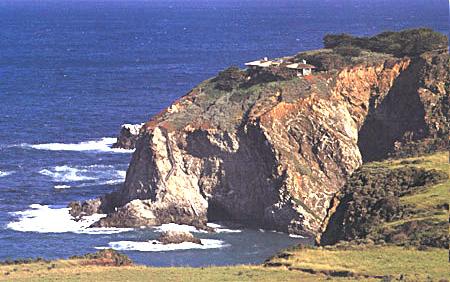
The little "cabin on the rocks" - the Della Walker residence, 1951. If you haven't
seen it as you've driven down the coast, you may have seen it in the 1959 movie,
"A Summer Place". Built for $125,000, with an addition designed by Wright after
the Walkers moved in in 1956, the house was one of Wright's favorites. Distinguished
by its stone terrace that juts out into Monterey Bay, the large stone chimney/
fireplace and the blue metal cantilevered roof, and the bank of windows. Two materials
have graced the living room roof, porcelain enamel, and copper. It is necessarily
cantilevered from the masonry core so that no weight rests on the corbelling bands
of glass. These windows block a direct breeze, but admit a gentle current of air.
The master bedroom has been enlarged."
Bixby Estate
Bixby Ocean House
Located 12 miles south of Carmel, California
Frank Lloyd Wright
"Every great architect is-necessarily-a great poet. He must be a great
original interpreter of his time, his day, his age." Frank Lloyd Write.
Cottage in the Woods - The 1920's home of Carmel artist Evelyn Calder cleverly
remodeled to provide maximum light, space, and privacy among the trees.
The Spare House - Built in 1925 and remodeled to remind its owners of their New England
roots and the Cape Cod houses of the 18th century.
The Carl Cherry Center for the Arts - A home created for the arts in the '30's, now a
gallery and theater reflecting the Bohemian spirit of past and present Carmel painters
and writer.
Scenic Masterpiece - Frank Lloyd Wright's perfect blending of structure and environment,
a home that becomes one with rock and water.
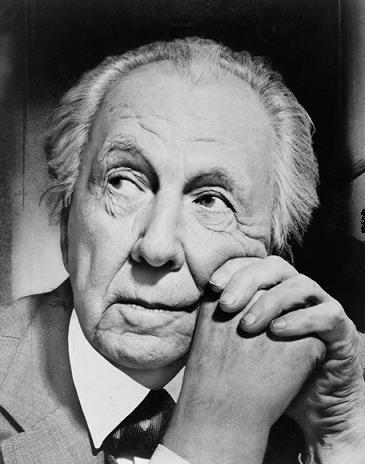
Frank Lloyd Wright was one of the most original American architects of the 20th
century. His buildings and ideas have affected the way offices and homes are designed
and organized today. Wright's willingness to look to various cultures for inspiration
allowed him to develop a unique style.
Wright believed in the power that good design has to make people more aware and
respectful of their surroundings and of nature. Wright designed office buildings,
houses, neighborhoods, public buildings, churches, and museums. He designed about
800 buildings. Of the 380 that were built, about 280 are still standing. The
influence of his 1901 Coined "Prairie style" of architecture (emphasizing the
use of interior light and open spaces in low, earth-hugging buildings) and
"Usonian" home design to American residential architecture
in homes across the country.
Prairie style houses usually have these features:
Low-pitched roof, Overhanging eaves, Horizontal lines, Central chimney,
Open floor plan, Rows of small windows, One-story projections
"A Usonian house is always hungry for the ground, lives by it, becoming an
integral feature of it." Frank Lloyd Wright. The Usonian designs is that the
houses should "spring from the ground and into the light." Each Usonian was
different, fine-tuned to the site. Wright hated basements and they certainly
weren't part of the Usonian plan, which used a concrete floor mat laid over
gravel and hot-water pipes as a source of radiant heating.
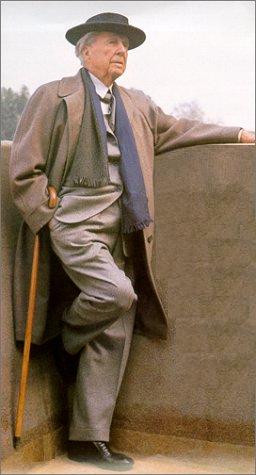
Frank Lloyd Wright gave us much in his life: June 8, 1867 - April 9, 1959
The road that runs north along the coast is Scenic Drive. It is a lovely way to see
the Carmel Coastline and views of Pebble Beach. One of Frank Lloyd Wright's houses
is on the cliff on the right. Robinson Jeffer's Tor House can be seen on the left side.
It is a stone house with a stone tower. Tours are available on Friday and Saturday
by reservation only. (12 rooms are open to view).
Houses Along World Famous Seventeen Mile Drive
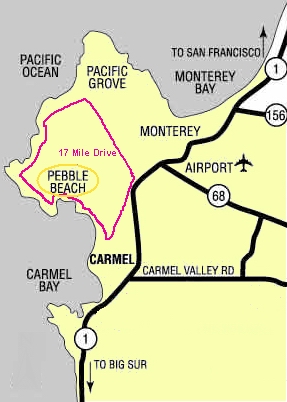
Map of Seventeen Mile Drive - Near to Carmel, CA.
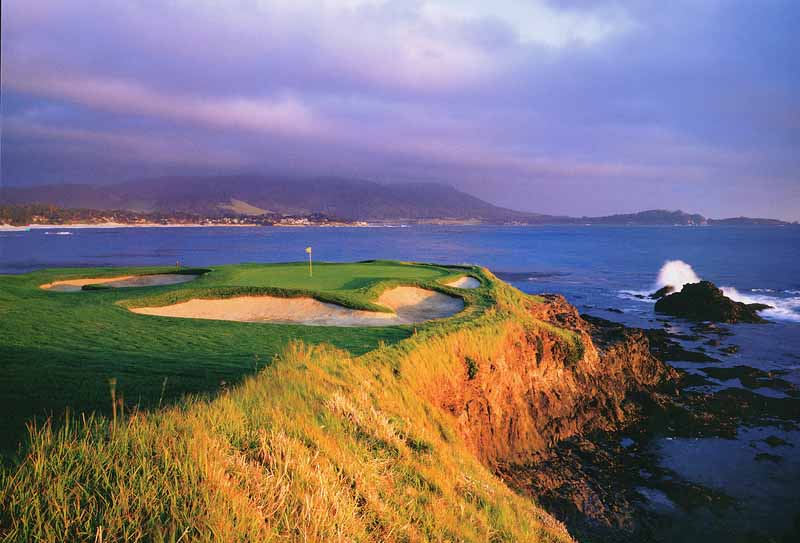
Pebble Beach Golf Course and Country Club on 17 Mile Drive
Famous Gold Course along Seventeen Mile Drive
WORLD FAMOUS 17 MILE DRIVE
17-Mile Drive: Began in 1881 as Pacific Improvement Company route for horse-drawn
excursions for tourists from Del Monte Lodge along the coast to Carmel Mission;
in 1919 Samuel FB Morse, grandnephew of the inventor of the Morse Code, developed
Pebble Beach from the Del Monte Forest part of the route and now 17-mile drive name
is used for scenic toll road through the area. SFB Morse Botanical Preserve honors
Morse's preservation of the forest.
World famous 17 mile drive is a private toll road and is located throughout the Pebble
Beach and Del Monte Forest area of Carmel. It is one of the most beautiful sights to
visit, with the landscapes of land and sea meeting each other in rocky magnificence.
Within this area are world class golf courses, such as the Pebble Beach Golf Links,
The Links at Spanish Bay,and Spyglass Hill Golf Course. Also to be seen is one of
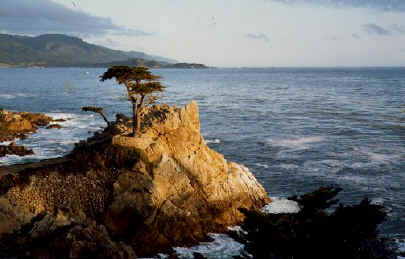
California's most photographed trees, the Lone Cypress. Many vantage stops are on
the 17 mile drive with vistas that make you just gasp in awe.
Lone Cypress Point
Along 17 Mile Drive
Address: Pebble Beach, California
Phone: 1 831 647-7500
Directions: Located in-between Carmel-by-the-Sea and Pacific Grove, with
entrances in both towns. This drive, is one of the highlights of the
Monterey Peninsula.
From promontories such as Rubicon Point in D.L. Bliss State Park you can see over
one hundred feet into the depths of Lake Tahoe, CA.. From the crest of Eagle Falls in
Emerald Bay State Park, you can see a brilliant panorama of Emerald Bay, Fannette
Island, Lake Tahoe, CA., and the distant Nevada shore.
The Carson and Tahoe Lumber and Fluming Company
(1873-1947)
Duane Leroy Bliss:
The Carson and Tahoe Lumber and Fluming Company was organized in 1873 with
Duane L. Bliss as president and general manger and H.M. Yerington, D.O. Mills
and J.A. Rigby as stockholders. It was probably the largest and most extensive
lumber operation serving the mines of the Comstock. At its peak of operation,
holdings included 50,000 acres of timber at Lake Tahoe and Lake Valley, three
mills at Glenbrook, two steamers two logging railroads, logging camps, and a
narrow gauge railroad. It operated several flumes to transport lumber down
the mountain to the railroad depots and also maintained a box factory in
Carson City.
D.L. Bliss State Park is named for a pioneering lumber man, railroad owner, and
banker of the region. His family donated 744 acres to the State Park system in 1929.
The nucleus of Emerald Bay State Park, including Vikingsholm, was given to the State
by Placerville lumber man Harvey West in 1953.
D.L. Bliss died in 1906 and H.M. Yerington died in 1910. They were succeeded by
their sons, W.S. Bliss and E.B. Yerington, who remained with the company until
the late 1920s. The Carson and Tahoe Lumber and Fluming Company was dissolved
in 1947.
Thank you!
PMD
Back to Previous Page
Web Counter